Brush Strokes: Evaluating Mixed-Media Digital Assets for Professional Design
In the evolving landscape of digital design, the demand for authentic, hand-crafted textures has never been higher. As interfaces become cleaner and more minimalist, designers often seek organic elements to add warmth, depth, and human touch to their compositions. This is where a curated collection like Brush Strokes becomes a valuable resource. Unlike standard vector shapes or flat digital illustrations, this set offers a distinct aesthetic achieved through a mixed technique involving watercolor, gouache, and acrylic paints.
For professionals aged 20 to 50 who are carefully selecting assets for client projects, personal branding, or web development, understanding the specific qualities of these files is crucial. This article explores what makes this particular set of 40 individual elements and 3 seamless patterns a viable option, how it compares to other digital art resources, and when it serves as the ideal choice versus when alternative tools might be better suited.
The Distinct Appeal of Mixed Media Techniques
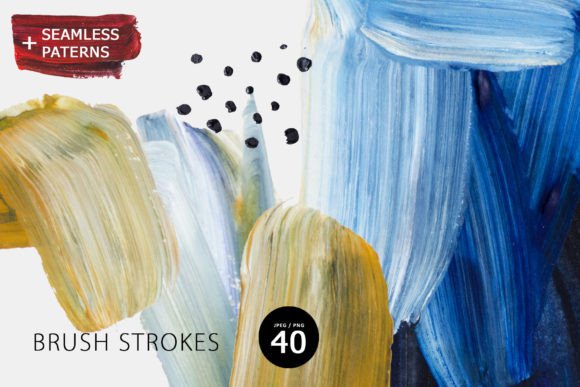
The primary differentiator of this Brush Strokes collection is its execution. Many digital brush packs rely solely on software simulations within programs like Photoshop or Procreate. While convenient, these can sometimes lack the unpredictable, tactile quality of real paint. This set, however, is created using actual physical media. The artist employs a special alternate application of paint to the brush, resulting in unique textures that blend the transparency of watercolor, the opacity of gouache, and the body of acrylics.
This hybrid approach creates visual interest that is difficult to replicate digitally. The edges are not perfectly smooth; they have the natural bleed and granulation of water-based media. For designers working on projects that require an artisanal or boutique feel, such as wedding invitations, organic skincare packaging, or lifestyle blog headers, these nuances provide immediate credibility and aesthetic appeal. The elements are presented on a white background, making them easy to isolate and integrate into various design compositions without extensive editing.
Technical Specifications and Usability
When evaluating digital assets, technical reliability is just as important as artistic style. This set consists of 40 files provided in both PNG and JPEG formats, ensuring compatibility with a wide range of design software. Whether you are using Adobe Illustrator, Canva, Affinity Designer, or web-based editors, these raster images are ready to use.
The resolution is a critical factor here. All graphic elements are rendered at 300 DPI (dots per inch), which is the industry standard for high-quality printing. This means the strokes will remain crisp and detailed whether used in a small business card logo or a large-format poster. Additionally, the inclusion of three seamless patterns at 4000 x 4000 pixels offers extended utility. These patterns can be tiled indefinitely for website backgrounds, textile designs, or wrapping paper, providing significant value beyond the individual stroke elements.
It is important to note that all files are in RGB color mode. This is optimal for screen-based projects, including web design, social media graphics, and digital presentations. However, designers planning for professional offset printing should be aware that converting RGB to CMYK may result in slight color shifts. For most modern digital-first projects, this is rarely an issue, but it is a tradeoff to consider for strict print workflows.
Comparing Brush Strokes to Alternative Resources
To make an informed decision, it helps to compare this type of asset pack against other common resources available to designers.
- Versus Vector Graphics: Vector files (SVG, AI) are infinitely scalable and editable. However, they often lack the organic texture and depth of raster-based paintings. If your project requires precise geometric scaling without any pixelation, vectors are superior. But if the goal is emotional resonance and texture, Brush Strokes offers a richness that vectors struggle to mimic without complex mesh gradients.
- Versus DIY Creation: Creating similar effects from scratch requires purchasing physical supplies, mastering mixed-media techniques, scanning at high resolutions, and spending hours on cleanup and isolation. For a busy professional, the time investment may not justify the cost savings. This pre-made set allows for immediate implementation, freeing up time for layout and typography.
- Versus Generic Stock Photos: Standard stock photography can feel impersonal or overused. Customizable elements like these allow for greater creative control. You can layer, rotate, and recolor the strokes to match specific brand guidelines, offering a semi-custom solution that feels unique to the project.
Practical Use Cases and Applications
Understanding where these elements fit best can help determine if they align with your current needs. Here are several realistic scenarios where this set excels:
- Logo Design Elements: For brands in creative industries, wellness, or arts, incorporating a single abstract stroke can soften a rigid logotype. It adds movement and energy without overwhelming the core message.
- Web Design Backgrounds: The seamless patterns are particularly useful for hero sections or footer areas on websites. They break up large blocks of solid color, adding subtle visual interest that does not distract from the main content or text.
- Marketing Materials: Social media posts often benefit from dynamic framing. Using these strokes as borders or accents around product photos can draw the eye and create a cohesive feed aesthetic.
- Print Collateral: Business cards, brochures, and flyers gain a tactile quality when these high-resolution strokes are used as background textures or dividers between sections of text.
Limitations and Decision Factors
While versatile, this resource is not a one-size-fits-all solution. There are specific limitations to consider before purchasing.
First, because these are raster images, they cannot be scaled up beyond their original dimensions without losing quality. If you need an element that spans a billboard, you must ensure the original file size is sufficient or use the patterns which are larger. Second, the abstract nature means they may not suit corporate, financial, or highly technical brands that require clean, structured, and serious visual language. In such contexts, the organic, free-flowing style might appear too casual or unstructured.
Additionally, since the files are pre-rendered, you cannot easily change the underlying texture of the paint itself. You can adjust hue and saturation, but you cannot turn a watercolor bleed into a sharp acrylic edge. If your project demands specific control over the paint behavior, creating custom assets or using advanced digital brush engines might be necessary.
Making the Right Choice for Your Project
Choosing the right design resources involves balancing aesthetics, efficiency, and technical requirements. The Brush Strokes set is an excellent choice for designers who value authenticity and want to incorporate hand-painted elements without the time commitment of creating them from scratch. It is particularly well-suited for projects that benefit from a soft, artistic, or human-centric vibe.
If your work primarily involves digital screens, social media, or small-to-medium print runs, the 300 DPI RGB files will serve you well. The bonus seamless patterns add extra versatility, making this a comprehensive toolkit for background creation. However, if your workflow relies heavily on infinite scalability or requires strict CMYK color accuracy for large-scale industrial printing, you may need to supplement this set with vector tools or specialized print-ready assets.
Ultimately, this collection represents a efficient bridge between traditional artistry and digital convenience. By understanding its strengths in texture and mood, and acknowledging its limitations in scalability and editability, you can effectively integrate these elements into your design workflow. Whether you are refreshing a brand identity or adding flair to a web layout, having high-quality, mixed-media assets on hand can significantly elevate the final output, providing that elusive "human touch" that resonates with modern audiences.